
CLICK TO SHOP OUR BLACK FRIDAY SALE!
*Excludes BioNude and subscriptions
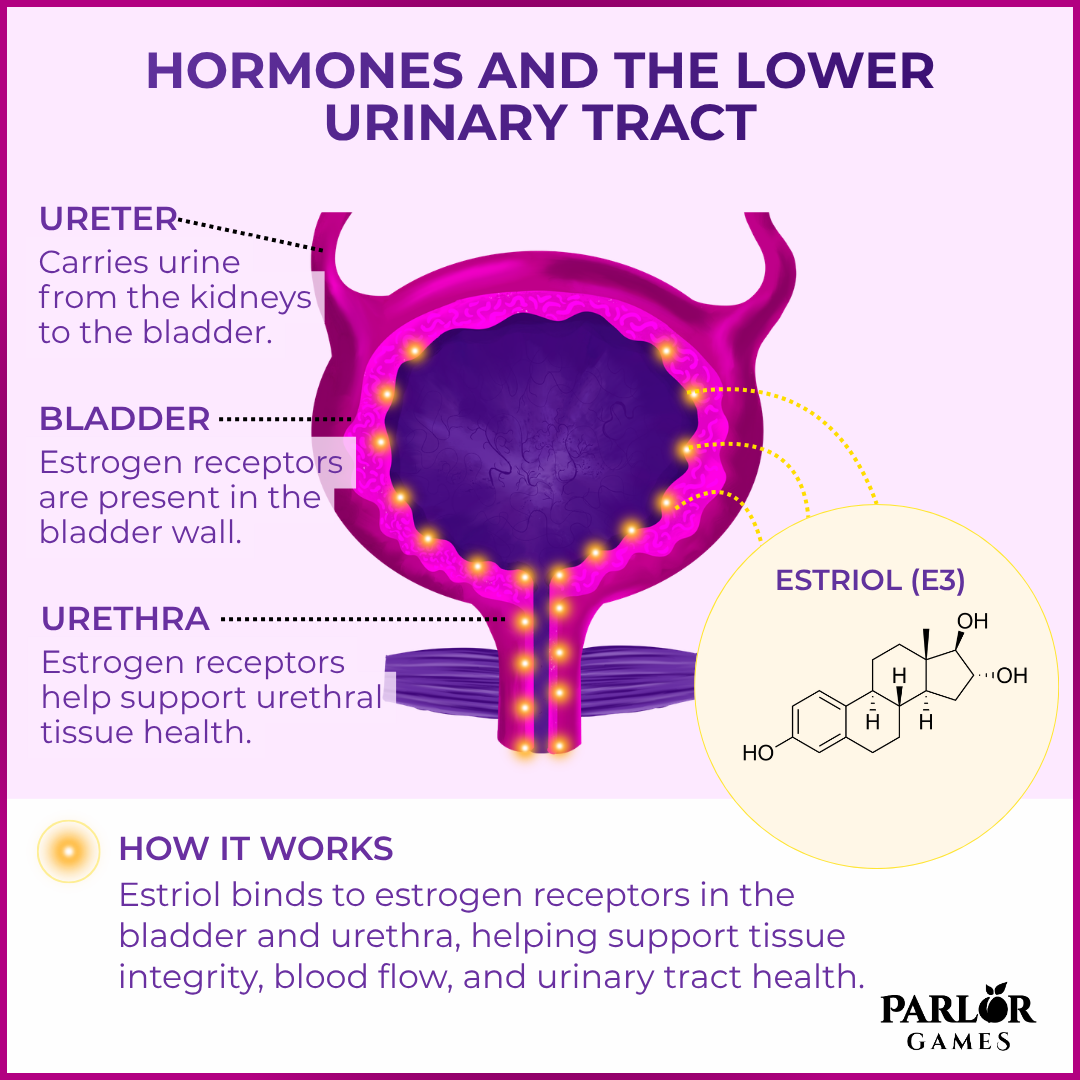
A 2020 review in NYU Case of the Month made a point that resonates with a lot of women: what shows up as urgency, frequency, or recurring discomfort in the lower urinary tract is often connected to hormonal changes rather than a simple mechanical issue. As estrogen levels shift during the menopause transition, the entire genitourinary system shifts with them — and understanding that connection can change how you think about what your body is telling you.
A 2020 review article in NYU Case of the Month — "Update in Female Hormonal Therapy: What the Urologist Should Know" by Nirit Rosenblum — raises a point worth sitting with: a lot of what shows up as lower urinary discomfort in midlife women is connected to hormonal changes, not just mechanics. The two systems are more intertwined than many people realize. Understanding that connection doesn't replace a conversation with your provider, but it does give you better language for having one.
Estrogen receptors are present throughout the lower urinary tract — including the bladder, urethra, and the surrounding pelvic tissues. When estrogen levels shift during the menopause transition, these tissues change along with them. There can be thinning of the epithelium, changes in blood flow, shifts in collagen content, and reduced elasticity. These are biological changes, and they're worth knowing about because they help explain a lot of what the body goes through in midlife.
From a urological perspective, the Rosenblum paper notes these changes can be connected to experiences like urinary urgency, frequency, discomfort, and a greater susceptibility to recurrent infections. The broader picture: what's sometimes described as a "bladder issue" may actually have hormonal roots. That's not a small thing to understand about your own body.
The paper describes genitourinary syndrome of menopause (GSM) as a chronic, progressive condition rather than a temporary inconvenience. Changes associated with GSM can include vaginal dryness, irritation, discomfort during sex, urinary urgency, frequency, and recurring infections. Unlike vasomotor changes such as hot flashes, these don't tend to resolve on their own over time.
One thing the article highlights: GSM is underrecognized, partly because women may not volunteer these experiences to their providers, and clinicians may not connect urinary changes to hormonal shifts. If you've been chasing what feels like a chronic bladder issue without resolution, it's worth raising the hormonal angle with a knowledgeable provider — because the two conversations may actually be one.
A significant portion of the Rosenblum review focuses on estrogen's role in urogenital tissue health, particularly local (vaginal) estrogen. The research discussed suggests that local estrogen is associated with supporting the integrity of vaginal and urethral tissue, improved blood flow in that region, and a more balanced vaginal microbiome — all of which are connected to overall urogenital comfort.
The paper distinguishes between systemic and local estrogen approaches. Systemic estrogen circulates throughout the body and addresses a wider range of hormonal changes. Local estrogen is applied directly to the vaginal and urethral tissue and is noted to have minimal systemic absorption — making it a consideration for many women, though individual circumstances always vary.
From a tissue-health standpoint, the research discussed in the paper suggests local estrogen is associated with improved urogenital comfort and a reduction in susceptibility to recurring urinary issues. The mechanism is described not as symptom masking, but as supporting the underlying tissue environment. That's a meaningful distinction.
The paper addresses common questions about estrogen approaches, particularly around safety. The review notes that low-dose vaginal estrogen is generally considered appropriate for many women, though individual circumstances and medical history always factor into those decisions — which is why that conversation belongs with a knowledgeable healthcare provider who knows your history.
A theme throughout Rosenblum's review is patient education. Many women don't pursue hormonal options — or don't know they exist — because of confusion or concern about hormones generally. The paper's message is that having accurate, individualized information makes a real difference in what women are able to consider for their own wellbeing.
The key insight of this review is that hormonal changes play a meaningful role in many of the urinary and urogenital experiences that midlife women navigate — and that framing these as purely mechanical issues often misses the fuller picture.
Rosenblum's update ultimately reframes common experiences not just as bladder concerns, but as hormone-connected changes in tissue health. Recognizing that connection gives women better language to bring to their providers, and better tools for understanding what their bodies are going through.
You can read the full study here: https://pmc.ncbi.nlm.nih.gov/articles/PMC8058921/
Parlor Games products are not intended to treat, cure, prevent, or mitigate disease or other medical conditions. Our products are not the subject of the studies discussed herein, and we do not claim that our products will have the same effects as those discussed in these articles. This information is being provided for educational purposes only, and is not intended to replace the advice of a medical professional.

Lorem ipsum dolor sit amet, consectetur adipiscing elit.
Lorem ipsum dolor sit amet, consectetur adipiscing elit.
Lorem ipsum dolor sit amet, consectetur adipiscing elit.
Lorem ipsum dolor sit amet, consectetur adipiscing elit.
Disclaimer: The information provided above is intended for educational and informational purposes only. Statements made have not been evaluated by the FDA nor are they intended to treat or diagnose. Any health concerns should be discussed and evaluated by your primary health care provider.
Parlor Games, LLC ● kate@parlor-games.com ● 5304 River Rd N Ste B ● Keizer OR 97303
Disclaimer: The information provided above is intended for educational and informational purposes only. Statements made have not been evaluated by the FDA nor are they intended to treat or diagnose. Any health concerns should be discussed and evaluated by your primary health care provider.
OUR HAPPINESS GUARANTEE
We want you to feel safe and confident trying any of our products. That's why we promise a 100% money-back guarantee on the purchase price of the first bottle of any of our products. Finding your balance takes time — so please give it a full 28 days. If after 28 days you're unhappy, or it just wasn't the right fit, simply contact us and we'll process a full refund of your purchase price upon receipt. Shipping fees are not refundable.
