
CLICK TO SHOP OUR BLACK FRIDAY SALE!
*Excludes BioNude and subscriptions
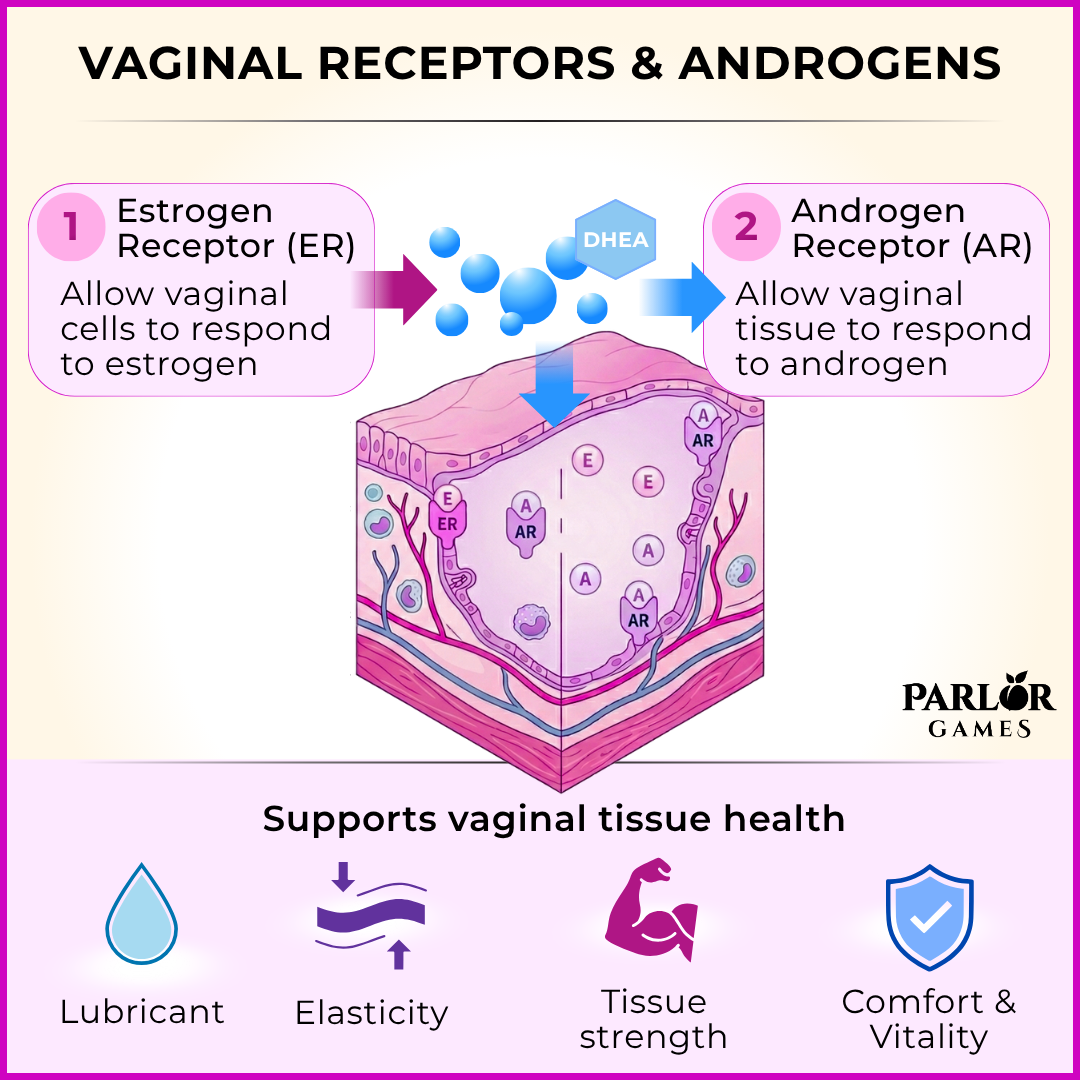
In this article "The vagina as source and target of androgens: implications for treatment of GSM/VVA, including DHEA," Cipriani, Maseroli, Ravelli, and Vignozzi, examine how androgen hormones affect vaginal tissue and what the research suggests for vaginal comfort in menopause and beyond.
The authors conducted a review of existing research, including laboratory studies of vaginal tissue, molecular studies of hormone receptors, and clinical research on menopause. They analyzed evidence showing how vaginal cells respond to hormones and how those hormones are processed within the tissue itself.
Rather than simply looking at whether DHEA helped, Cipriani et al., explored the actual structure of the vaginal tissues to better understand what they might need in menopause and beyond...
The article explains that vaginal tissue contains androgen receptors, which means the vagina can respond directly to androgen hormones such as testosterone and dehydroepiandrosterone (DHEA). The researchers also describe evidence that vaginal cells contain the enzymes needed to convert hormone precursors into active hormones locally. This process, known as intracrinology, allows the vagina to produce small amounts of active estrogen and androgen inside the tissue.
According to the authors, this finding changes how scientists think about vaginal biology. Rather than being a passive tissue that only responds to circulating estrogen, the vagina functions as a locally active hormone environment that both produces and responds to sex hormones.
The review also examines how hormonal changes during menopause affect vaginal tissue. As estrogen and androgen levels decline with age, vaginal tissues can become thinner, less elastic, and less lubricated. These changes are associated with genitourinary syndrome of menopause, which can involve experiences such as dryness, irritation, discomfort with intercourse, and urinary changes.
Based on the research reviewed, the authors suggest that androgens may play a role in supporting overall vaginal comfort, suppleness, and lubrication. Because of this, supporting local androgen activity may contribute to vaginal comfort during menopause.
The article discusses intravaginal DHEA as one example of this approach. When applied locally, DHEA can be converted by vaginal cells into both estrogen and androgen within the tissue, allowing the vagina to generate the hormones it needs directly where they are required.
The authors conclude that understanding the vagina as both a source and target of androgens may help expand our knowledge of vaginal biology in midlife. Supporting local hormone activity in vaginal tissue may contribute to feelings of comfort and ease during intimacy and daily life.
You can view the full study, here: https://www.tandfonline.com/doi/abs/10.1080/136971...
Parlor Games products are not intended to treat, cure, prevent, or mitigate disease or other medical conditions. Our products are not the subject of the studies discussed herein, and we do not claim that our products will have the same effects as those discussed in these articles. This information is being provided for educational purposes only, and is not intended to replace the advice of a medical professional.

Lorem ipsum dolor sit amet, consectetur adipiscing elit.
Lorem ipsum dolor sit amet, consectetur adipiscing elit.
Lorem ipsum dolor sit amet, consectetur adipiscing elit.
Lorem ipsum dolor sit amet, consectetur adipiscing elit.
Disclaimer: The information provided above is intended for educational and informational purposes only. Statements made have not been evaluated by the FDA nor are they intended to treat or diagnose. Any health concerns should be discussed and evaluated by your primary health care provider.
Parlor Games, LLC ● kate@parlor-games.com ● 5304 River Rd N Ste B ● Keizer OR 97303
Disclaimer: The information provided above is intended for educational and informational purposes only. Statements made have not been evaluated by the FDA nor are they intended to treat or diagnose. Any health concerns should be discussed and evaluated by your primary health care provider.
OUR HAPPINESS GUARANTEE
We want you to feel safe and confident trying any of our products. That's why we promise a 100% money-back guarantee on the purchase price of the first bottle of any of our products. Finding your balance takes time — so please give it a full 28 days. If after 28 days you're unhappy, or it just wasn't the right fit, simply contact us and we'll process a full refund of your purchase price upon receipt. Shipping fees are not refundable.
