
CLICK TO SHOP OUR BLACK FRIDAY SALE!
*Excludes BioNude and subscriptions
What is it, why are we talking about boosting it, and does it really 'stop' aging?
When it comes to supplements, there is always the newest 'thing' - anyone else remember vampire facials? But, that doesn't mean that some things don't have merit - it just means understanding what different things are and how they work (and the data behind them).
Let's dive into NAD+ and see why it's become so popular in supplements and skincare!
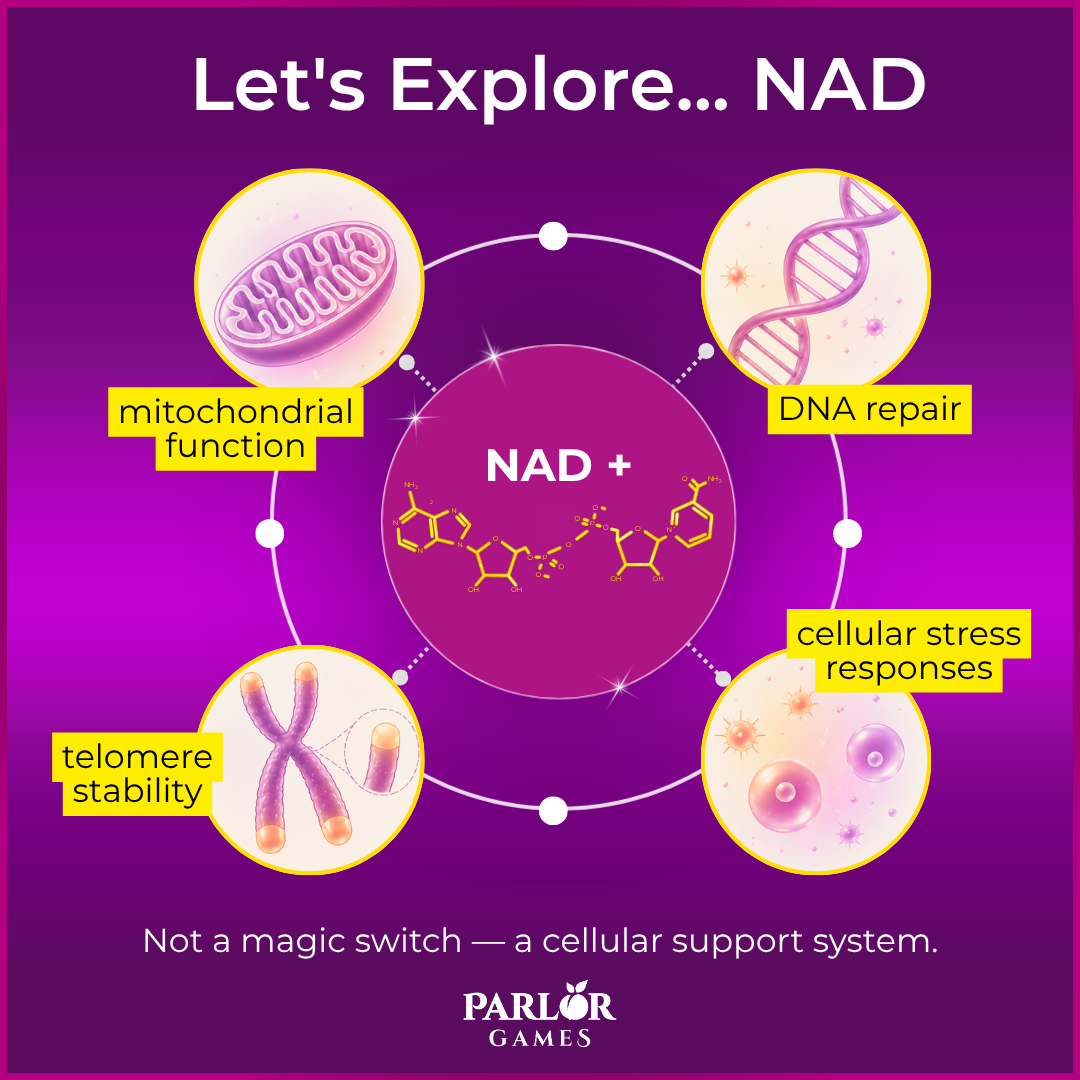
NAD+ (nicotinamide adenine dinucleotide) is a coenzyme found in every single cell in your body, and it is not optional. It is central to how your cells produce energy, and it plays a role in aging-related pathways. At a basic level, NAD+ helps convert the food you eat into usable cellular energy through mitochondrial function, but that is only part of the story.
Where things get interesting is that NAD+ also acts as a required fuel source for enzymes involved in DNA repair and cellular stress responses, particularly sirtuins and PARPs (poly ADP-ribose polymerases). These systems are directly tied to how well your cells maintain themselves over time (Imai & Guarente, 2014; Verdin, 2015).
And yes, NAD+ levels decline with age.
This decline has been consistently observed across multiple tissues and is associated with reduced mitochondrial function, increased oxidative stress, and impaired DNA repair (Massudi et al., 2012; Zhu et al., 2015). In other words, the drop in NAD+ is not just a passive marker of aging — it is functionally involved in how and why aging happens at the cellular level.
So naturally, the next question became: can we boost it?
Short answer: kind of. Long answer: it is complicated.
Now, let's burst the bubble first (sorry!). Nothing stops or reverses aging. Well... nothing we know about. Maybe Jeff and Elon know about it, but — sadly — we don't!
Most of the excitement around NAD+ comes from studies using precursors such as NMN (nicotinamide mononucleotide) and NR (nicotinamide riboside), which the body can convert into NAD+. In animal models, boosting NAD+ has shown improvements in metabolic function, mitochondrial activity, and even lifespan in some contexts (Mills et al., 2016; Zhang et al., 2016).
In humans, the data is more measured. Supplementation with NAD+ precursors can increase NAD+ levels in blood and tissues, but the downstream effects on aging, performance, or longevity are still being studied and are far less dramatic than headlines suggest (Elhassan et al., 2019; Martens et al., 2018).
And importantly, NAD+ does not "stop" aging.
Aging is not a single pathway you can switch off. It is a complex, multi-system process involving genomic instability, mitochondrial dysfunction, cellular senescence, hormonal shifts, and immune changes. NAD+ is one piece of that puzzle, not the master switch.
Where NAD+ does appear to have meaningful relevance is in:
Your skin is metabolically active tissue, and like the rest of your body, it experiences a decline in NAD+ over time. This contributes to slower turnover and visible signs of aging like dullness, fine lines, and loss of elasticity. UV exposure further accelerates NAD+ depletion, increasing DNA damage and oxidative stress (Ryu et al., 2018).
Topical strategies aimed at supporting NAD+ pathways are emerging as a way to target this locally, rather than relying solely on systemic supplementation. The idea is not that a cream will reverse aging, but that it may help skin look and feel its best.
That is where sunflower-derived actives designed to support NAD+ pathways come into play. RejuveNAD, a sunflower-derived active found in some topical formulas, is designed with this goal in mind — not hype or "age reversal," but supporting skin that looks healthy, refreshed, and resilient over time.
Aging is not something you "stop," but we can give our skin the ingredients that help it look its most vibrant — for longer!
This article is for educational and general wellness purposes only. It is not medical advice and is not intended to diagnose, treat, cure, or prevent any disease. If you are noticing changes in your body or have questions about your health, please consult a knowledgeable healthcare provider.
Imai S, Guarente L. NAD+ and sirtuins in aging and disease. Trends Cell Biol. 2014.
Verdin E. NAD+ in aging, metabolism, and neurodegeneration. Science. 2015.
Massudi H et al. Age-associated changes in oxidative stress and NAD+ metabolism. PLoS One. 2012.
Zhu XH et al. NAD+ levels decline with age in human brain. Neurobiology of Aging. 2015.
Mills KF et al. Long-term administration of NMN mitigates age-associated physiological decline in mice. Cell Metab. 2016.
Zhang H et al. NAD+ repletion improves mitochondrial function and extends lifespan in mice. Science. 2016.
Elhassan YS et al. Nicotinamide riboside supplementation in humans. Cell Metabolism. 2019.
Martens CR et al. Chronic nicotinamide riboside supplementation is well-tolerated and elevates NAD+ in healthy adults. Nat Commun. 2018.
Ryu D et al. NAD+ repletion improves skin health and mitochondrial function under stress. Cell Reports. 2018.
Parlor Games products are not intended to treat, cure, prevent, or mitigate disease or other medical conditions. Our products are not the subject of the studies discussed herein, and we do not claim that our products will have the same effects as those discussed in these articles. This information is being provided for educational purposes only, and is not intended to replace the advice of a medical professional.

Lorem ipsum dolor sit amet, consectetur adipiscing elit.
Lorem ipsum dolor sit amet, consectetur adipiscing elit.
Lorem ipsum dolor sit amet, consectetur adipiscing elit.
Lorem ipsum dolor sit amet, consectetur adipiscing elit.
Disclaimer: The information provided above is intended for educational and informational purposes only. Statements made have not been evaluated by the FDA nor are they intended to treat or diagnose. Any health concerns should be discussed and evaluated by your primary health care provider.
Parlor Games, LLC ● kate@parlor-games.com ● 5304 River Rd N Ste B ● Keizer OR 97303
Disclaimer: The information provided above is intended for educational and informational purposes only. Statements made have not been evaluated by the FDA nor are they intended to treat or diagnose. Any health concerns should be discussed and evaluated by your primary health care provider.
OUR HAPPINESS GUARANTEE
We want you to feel safe and confident trying any of our products. That's why we promise a 100% money-back guarantee on the purchase price of the first bottle of any of our products. Finding your balance takes time — so please give it a full 28 days. If after 28 days you're unhappy, or it just wasn't the right fit, simply contact us and we'll process a full refund of your purchase price upon receipt. Shipping fees are not refundable.
