
CLICK TO SHOP OUR BLACK FRIDAY SALE!
*Excludes BioNude and subscriptions
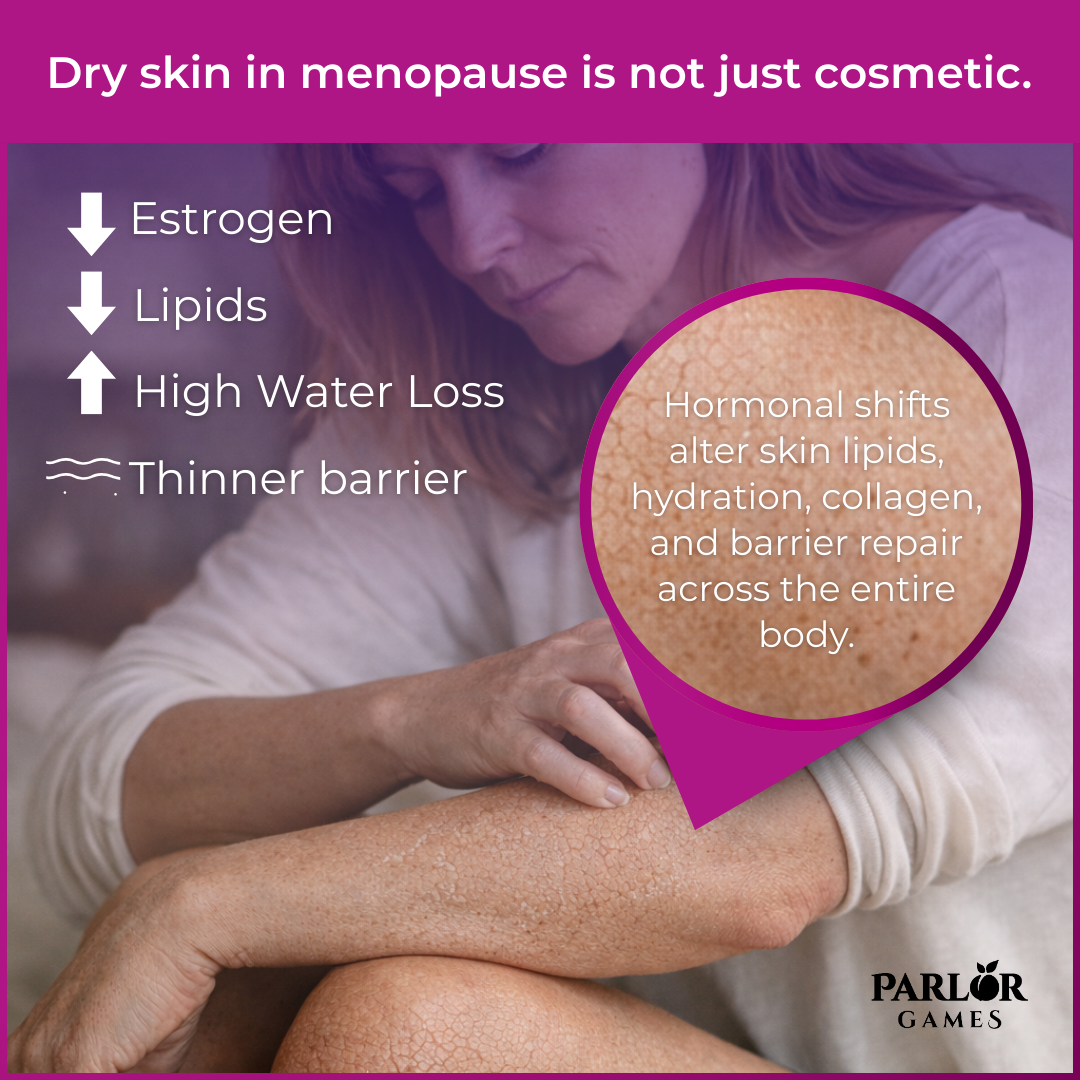
Have you joined the “why am I so dry everywhere” club? Well, you're not imagining it and you are not just dehydrated. Dry, itchy, uncomfortable skin is one of those sneaky perimenopause and menopause symptoms that rarely gets talked about, mostly because women are told to blame stress, weather, aging, or their moisturizer instead of their hormones. The science tells a different story...
https://link.springer.com/chapter/10.1007/978-981-96-0239-1_17
This is a clinical review aimed at healthcare practitioners that synthesizes findings from dermatology and menopause research.
This article reviews existing clinical studies and observational data on how declining and fluctuating estrogen levels affect the structure and function of the skin. The review explains that estrogen plays a role in maintaining skin thickness, hydration, collagen content, elasticity, and barrier function.
As estrogen levels decline in perimenopause and menopause, the skin produces less collagen and fewer natural moisturizing factors, the outer skin barrier becomes less effective, and water loss through the skin increases.
The result is skin that is drier, thinner, more fragile, and more prone to irritation over the entire body, not just the face. The article also notes that these changes can begin during perimenopause, when hormones are fluctuating, not only after periods have stopped.
https://www.tandfonline.com/doi/abs/10.1080/13697137.2022.2050206
This is a comprehensive narrative review of the effects of menopause on skin, hair, and other hormone-responsive tissues.
This paper draws on dermatologic research, endocrine studies, and clinical observations to describe how estrogen decline alters sebaceous gland activity, skin lipid composition, hydration, wound healing, and immune function in the skin.
The authors highlight that reduced estrogen is associated with increased transepidermal water loss, decreased skin surface lipids, and impaired barrier integrity, all of which contribute to widespread dryness and increased sensitivity. This review also discusses how aging and menopause interact, making it difficult to separate what is driven by chronological aging versus hormonal change, but emphasizes that menopause introduces distinct biological shifts that accelerate dryness and loss of skin resilience.
Together, these two reviews support a consistent scientific conclusion. Dry skin in perimenopause and menopause is not just a surface-level skincare issue or a matter of external hydration. It reflects real, hormone-driven changes in skin structure, moisture regulation, and barrier function. Both articles emphasize that these changes can be experienced across the entire body and may begin earlier than many women expect — during the hormonally volatile years of perimenopause.
So, if you are noticing dry, tight, itchy, or more sensitive skin in your 40s or 50s, the science says this is not random and it is not just "getting older." The research summarized in these two review articles shows that hormonal changes in perimenopause and menopause directly affect how your skin holds moisture, produces oils, renews itself, and maintains its protective barrier. In practical terms, your skin is losing some of the biological tools it once used to stay hydrated and resilient.
This article is for educational and general wellness purposes only. It is not medical advice and is not intended to diagnose, treat, cure, or prevent any disease. If you are noticing changes in your body or have questions about your health, please consult a knowledgeable healthcare provider.
Parlor Games products are not intended to treat, cure, prevent, or mitigate disease or other medical conditions. Our products are not the subject of the studies discussed herein, and we do not claim that our products will have the same effects as those discussed in these articles. This information is being provided for educational purposes only, and is not intended to replace the advice of a medical professional.

Lorem ipsum dolor sit amet, consectetur adipiscing elit.
Lorem ipsum dolor sit amet, consectetur adipiscing elit.
Lorem ipsum dolor sit amet, consectetur adipiscing elit.
Lorem ipsum dolor sit amet, consectetur adipiscing elit.
Disclaimer: The information provided above is intended for educational and informational purposes only. Statements made have not been evaluated by the FDA nor are they intended to treat or diagnose. Any health concerns should be discussed and evaluated by your primary health care provider.
Parlor Games, LLC ● kate@parlor-games.com ● 5304 River Rd N Ste B ● Keizer OR 97303
Disclaimer: The information provided above is intended for educational and informational purposes only. Statements made have not been evaluated by the FDA nor are they intended to treat or diagnose. Any health concerns should be discussed and evaluated by your primary health care provider.
OUR HAPPINESS GUARANTEE
We want you to feel safe and confident trying any of our products. That's why we promise a 100% money-back guarantee on the purchase price of the first bottle of any of our products. Finding your balance takes time — so please give it a full 28 days. If after 28 days you're unhappy, or it just wasn't the right fit, simply contact us and we'll process a full refund of your purchase price upon receipt. Shipping fees are not refundable.
