
CLICK TO SHOP OUR BLACK FRIDAY SALE!
*Excludes BioNude and subscriptions
We are all familiar with the unpleasant ‘someone has threaded wire into my urethra’ feeling that signals the dawning of a UTI.
What starts as a small discomfort quickly turns to full blown burning and stinging every time we sit down to pee. We are then stuck in a catch-22; drink less means pee less, but worse for UTI, drink more is better for UTI, but then pee more. 😭 Right as we plan to get on a plane for several hours...!
We have some great blogs on ways to keep the vagina, bladder, and entire genitourinary complex happy (Hello, D-Mannose…), but something that is equally important is understanding a few key things:
1. Why do UTIs often become more frequent as we age?
2. Why aren't antibiotics working — or why do they work only for a UTI to return a week later?!
3. How does UTI presentation change with age (yes, sometimes we don't FEEL a UTI!)
4. What happens when UTIs go untreated?
So, let's take a look…
There are some basics to UTI hygiene that many women already know — things like avoiding soap in the urethra, avoiding pads that can transfer bacteria, peeing after sex, and changing out of sweaty lycra. Plus, there are the well-known lifestyle factors — drinking enough water and avoiding sugar — that can play a role in UTI frequency and severity.
But let's face it, getting a UTI once a month isn't adding up even if you did hang out in sweaty lycra and skip water at lunch.
There is a strong link between estrogen levels and UTI frequency, especially as women go through menopause and beyond. Estrogen is critical for urethral, vulvar, and vaginal health, and the decline in estrogen that comes with menopause is associated with changes in the genitourinary environment. Estriol — the gentlest form of estrogen — is particularly involved in the health of these tissues.
How? Let's look at some of the key ways:
Skin cell health: Estrogen is involved in keeping the outer layer of cells healthy and — perhaps most importantly — supporting healthy cell turnover. As estrogen declines, so does this regular renewal process.
Collagen reserves: Collagen (as we may all know from constant advertising bombardment…) keeps wrinkles at bay — but it also helps maintain tissue integrity. As we age, the skin of the urinary tract, vulva, and vagina loses collagen and starts to thin. Thinning skin can result in small micro-tears, and estrogen is involved in collagen formation.
pH balance: The vaginal microbiome is acidic, which helps create an environment that is less hospitable to unwanted bacteria. Without adequate estrogen, the pH can rise, shifting that balance. More vaginal bacteria can increase the chance of spreading to the urethra.
Mucous membranes: One of estrogen's important functions is mucous membrane health. When mucous membranes thin, we feel this as dryness of the tissue. This has a ripple effect — itching increases, skin is more vulnerable, and bacteria have more opportunity to thrive and move around.
So, it's not one simple problem. It's the overall decline in estrogen that is associated with changes in the environment where bacteria can get a stronger foothold and have an easier time spreading from the anus, perineum, and vagina into the urethra.
If a UTI is just bacteria, why doesn't a good strong dose of antibiotics do the job? Well, there are a few reasons…
Issue |
What It Means |
Why It Matters |
Different bacteria cause UTIs |
Most are E. coli, but others (Klebsiella, Proteus, Enterococcus) require different medications. |
The antibiotic that works for one organism may do nothing for another. |
Antibiotic resistance |
Some bacteria have adapted and no longer respond to common antibiotics. |
Symptoms persist or return quickly because the drug couldn't clear the bacteria. |
Recurrent infections may involve new organisms |
Not every "repeat UTI" is the same bacteria coming back. |
Each infection may require a different targeted treatment. |
Incorrect or incomplete treatment |
Short or mismatched courses allow bacteria to linger. |
Leads to chronic inflammation, recurring symptoms, and more antibiotic use. |
Repeated courses of antibiotics can disrupt the vaginal and gut microbiomes, eliminating not only harmful bacteria but also the good bacteria that help maintain pH, immune function, and tissue integrity.
This disruption is associated with a higher likelihood of yeast infections, digestive problems, and (ironically) future UTIs. Heavy antibiotic exposure also increases the chance of antibiotic resistance, meaning the usual medications may become less effective over time. This doesn't mean antibiotics should be avoided when they're needed — it simply means that supporting tissue health, understanding the underlying environment, and using targeted treatment strategies all matter.
As many of us become caregivers to elderly parents — or already are — it's important to understand how differently UTIs can present in older women. What can be a nuisance in our younger years can be much more serious, and so UTIs in older adults often get missed.
Studies have shown that UTIs are one of the most frequently diagnosed infections in older adults (between 15–30%), and around 6.25% of infection-related deaths in elderly patients are attributed to UTIs.
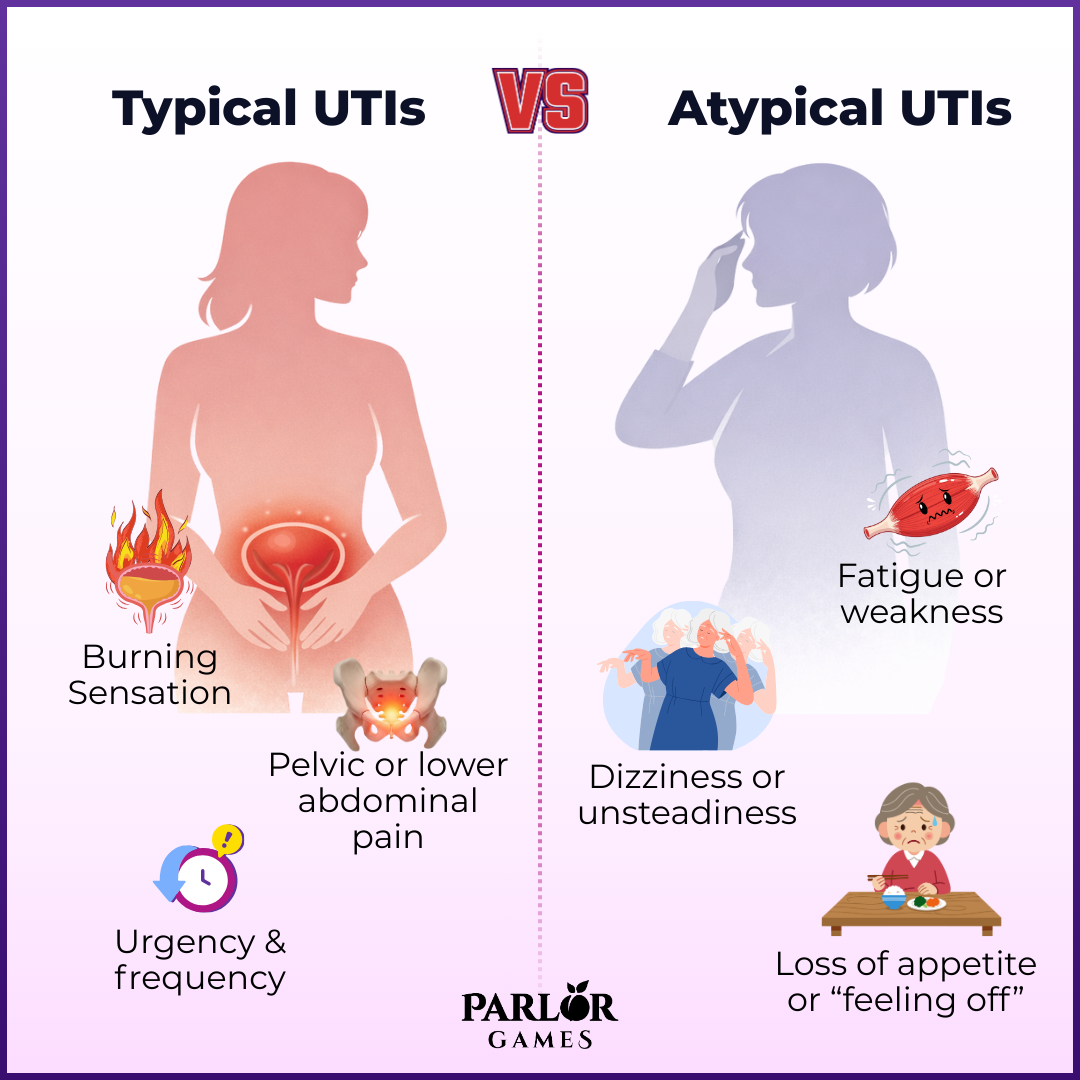
Let's compare:
🔥 Burning with urination (dysuria)
🚽 Urgency and frequency
🌫️ Cloudy or strong-smelling urine
⚡ Lower abdominal or pelvic pain
🩸 Occasionally blood in urine
❗ Symptoms appear quickly and are easy to identify
🧠 Mental status stays normal
🦠 Usually localized infection without systemic symptoms
🧩 Fewer urinary symptoms — often no burning
💤 Generalized fatigue or "feeling off"
🤒 Low-grade fever or no fever at all
🧠 Confusion, delirium, agitation, or sudden behavioral change
🥴 Dizziness, falls, or unsteadiness
🍽️ Loss of appetite
⚕️ Worsening of existing conditions
🩺 Symptoms may be vague, slow to appear, or misattributed to "age"
🚑 Higher risk of rapid progression to serious infection (e.g., kidney infection or sepsis)
For younger women, UTIs with more common symptoms tend to stay localized to the vaginal-urethral complex, with some women experiencing pelvic or abdominal pain. For older women, the picture is often more cognitive — confusion or behavioral changes that caregivers may not immediately connect to a urinary infection.
An untreated UTI doesn't always stay "just a bladder infection." In many women — especially in midlife and beyond — bacteria can travel upward from the bladder into the kidneys. Kidney infections (pyelonephritis) can lead to high fever, lower back pain, and sometimes hospitalization. If the infection continues to spread, it can enter the bloodstream, causing urosepsis, which is serious but preventable with timely treatment.
Even when complications don't escalate that far, untreated infections can cause ongoing inflammation, bladder irritation, and worsening urgency or frequency that disrupts daily life. It's worth taking a recurrent pattern seriously and having a longer conversation with your doctor about what a lasting approach looks like for your situation.
There is, however, some genuinely interesting science about estrogen's role in tissue health that's worth knowing — and worth bringing up with your healthcare provider if recurrent infections have become a pattern for you.
Parlor Games products are not intended to treat, cure, prevent, or mitigate disease or other medical conditions. Our products are not the subject of the studies discussed herein, and we do not claim that our products will have the same effects as those discussed in these articles. This information is being provided for educational purposes only, and is not intended to replace the advice of a medical professional.

Lorem ipsum dolor sit amet, consectetur adipiscing elit.
Lorem ipsum dolor sit amet, consectetur adipiscing elit.
Lorem ipsum dolor sit amet, consectetur adipiscing elit.
Lorem ipsum dolor sit amet, consectetur adipiscing elit.
Disclaimer: The information provided above is intended for educational and informational purposes only. Statements made have not been evaluated by the FDA nor are they intended to treat or diagnose. Any health concerns should be discussed and evaluated by your primary health care provider.
Parlor Games, LLC ● kate@parlor-games.com ● 5304 River Rd N Ste B ● Keizer OR 97303
Disclaimer: The information provided above is intended for educational and informational purposes only. Statements made have not been evaluated by the FDA nor are they intended to treat or diagnose. Any health concerns should be discussed and evaluated by your primary health care provider.
OUR HAPPINESS GUARANTEE
We want you to feel safe and confident trying any of our products. That's why we promise a 100% money-back guarantee on the purchase price of the first bottle of any of our products. Finding your balance takes time — so please give it a full 28 days. If after 28 days you're unhappy, or it just wasn't the right fit, simply contact us and we'll process a full refund of your purchase price upon receipt. Shipping fees are not refundable.
