
CLICK TO SHOP OUR BLACK FRIDAY SALE!
*Excludes BioNude and subscriptions
Guest Authored by Dr. Robyn Kutka
If you’re taking oral progesterone and thinking, “I sleep a bit better… but why do I still feel off?” You’re not imagining things — and you’re not doing anything wrong.
This is something I see all the time in perimenopausal women.
You might notice:
And the confusing part? You’re already “on progesterone.”
So what’s going on? The answer usually isn’t whether you’re taking progesterone — it’s how your body is processing it.
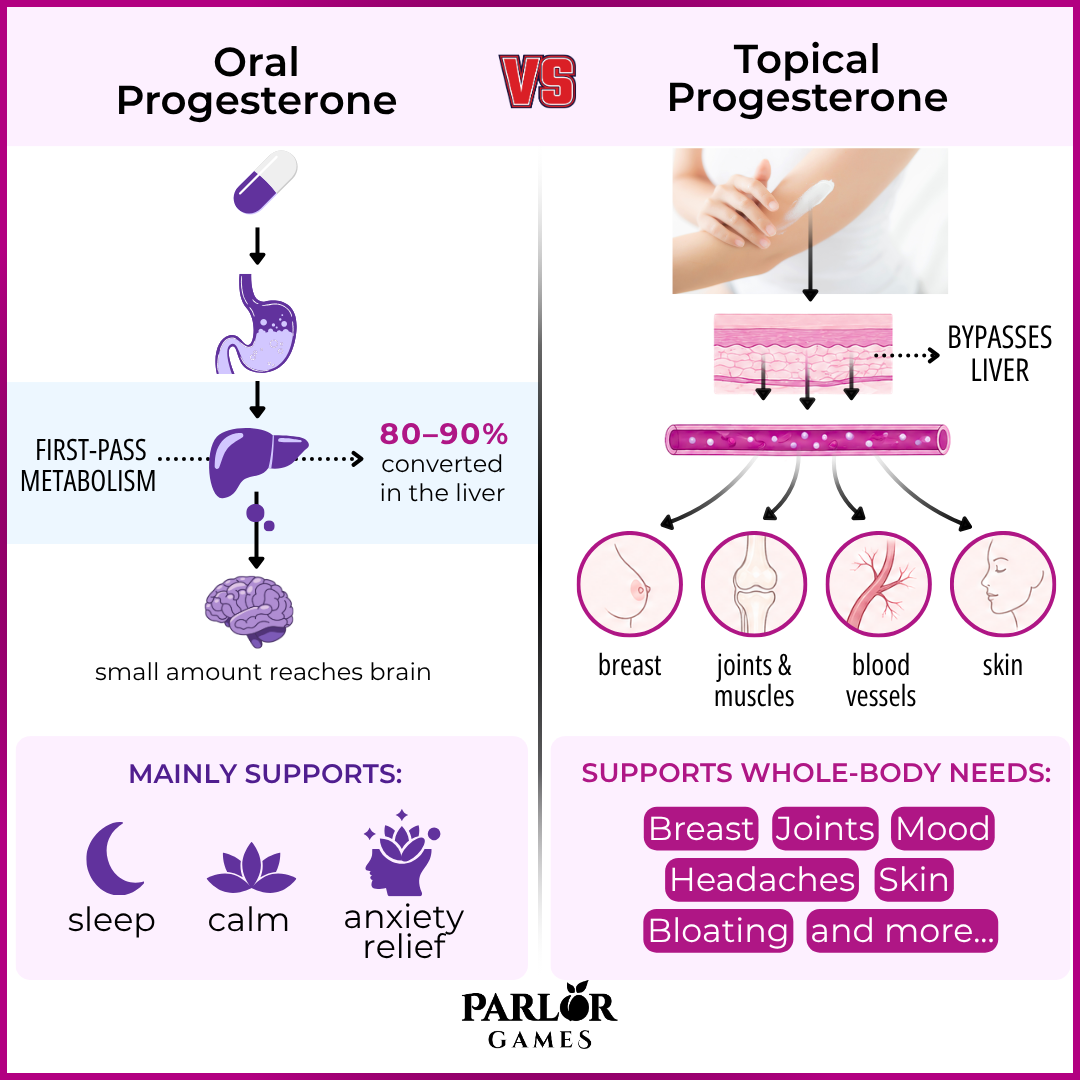
When you swallow progesterone, it doesn’t go straight into your bloodstream. First, it goes to your liver. This is called first-pass metabolism, and it matters a lot more than most women are ever told.
Here’s the key takeaway:
During first pass, about 80–90% of oral progesterone is converted into other substances before it ever reaches your body as progesterone. That’s right. That means the vast majority of the oral progesterone you take, never actually gets to be used by the body as progesterone! If you’re using oral progesterone, your body is mostly getting progesterone’s breakdown products.The main one being allopregnanolone. And this isn’t a bad thing — in fact, it explains why oral progesterone can feel helpful in some ways.
Allopregnanolone is a calming chemical for the brain. It works at GABA receptors — the same calming pathway affected by sleep meds, alcohol and anti-anxiety medications.
That’s why oral progesterone often helps with:
If using oral progesterone helped your sleep but didn’t fix everything else, that actually makes perfect sense. Your brain got what it needed. Your body tissues likely didn’t.
While oral progesterone does a great job supporting the nervous system, much less progesterone reaches the rest of your body.
That includes:
So you can end up in a frustrating middle ground: “I feel calmer… but my body still feels hormonally chaotic.” This is especially common in perimenopause, when estrogen is constantly swinging high and low and progesterone production is already decreased and inconsistent.
When applied to the skin, topical (transdermal) progesterone works differently. It bypasses the liver’s first pass effect, meaning:
For many women, this can help with:
A simple way to think about it:
Oral progesterone mainly supports the brain. Transdermal progesterone better supports the body.
They’re not competing — they’re doing different jobs.
Perimenopause isn’t a simple hormone deficiency. It’s a timing, delivery, and adequacy issue.
Many women feel best when they use enough progesterone to support the full body. This can often be done with topical progesterone alone. But for those women using systemic estradiol (i.e. the estradiol patch or pill), it can look different…
This is especially true if:
If you’re taking oral progesterone and still struggling, it does not mean:
More often, it means progesterone isn’t being delivered in a way your body can fully use. And that’s an easy problem to solve … with transdermal progesterone and Vibrant Third.

Lorem ipsum dolor sit amet, consectetur adipiscing elit.
Lorem ipsum dolor sit amet, consectetur adipiscing elit.
Lorem ipsum dolor sit amet, consectetur adipiscing elit.
Lorem ipsum dolor sit amet, consectetur adipiscing elit.
Disclaimer: The information provided above is intended for educational and informational purposes only. Statements made have not been evaluated by the FDA nor are they intended to treat or diagnose. Any health concerns should be discussed and evaluated by your primary health care provider.
Parlor Games, LLC ● kate@parlor-games.com ● 5304 River Rd N Ste B ● Keizer OR 97303
Disclaimer: The information provided above is intended for educational and informational purposes only. Statements made have not been evaluated by the FDA nor are they intended to treat or diagnose. Any health concerns should be discussed and evaluated by your primary health care provider.
28 Day Challenge Subscription Details

We ship you a 28 day supply of Silky Peach Cream for only $29 (more than 25% off our normal price) when you sign up for Subscribe & Save.
Follow the directions we include in the package and apply Silky Peach cream on your tender bits for 28 days.

Decision Day:
5 days before your subscription rebills, we’ll send you an email reminder with a link. If you decide Silky Peach is nice but not your thing… you can click that link and cancel your subscription without even talking to anyone. No hassle — no questions asked.
If you are like 72% of our Silky Peach customers, you’ll love it and can't imagine life without it. In that case, do nothing, and we’ll welcome you to the Parlor Games family and ship Silky Peach Cream to your door step every month for the same discounted price of $29 — locked in for as long as you remain a subscriber.

Important note about our easy-breezy subscriptions:
We know that some companies make it hard to cancel a subscription — that’s not us. Our mission is to save the world — one vagina at a time! If you decide you don’t need Estriol as an ongoing solution for dryness, incontinence, UTIs and keeping sex fun and comfortable again, we understand. Five days before we ship your next order, you'll receive an email with a link to cancel right there in the message.
No hunting, no searching, we got you. Respect is where it’s at.
FYI – Estriol is beneficial for skin integrity and mucous membranes. It’s great for vaginal atrophy and also amazing for use on the face and neck. Applying a small amount — about 1 pump — can help build the collagen and plump up the cells to reduce wrinkles. Who knew!!
OUR HAPPINESS GUARANTEE
We want you to feel safe and confident trying any of our products. That's why we promise 100% money-back guarantee on the purchase price of the first bottle of any of our products. Balancing hormones DOES take some time, so please try it for 28 days. If after 28 days you are unhappy, or the product just hasn't worked for you, simply contact us and we'll process a refund of your full purchase price upon receipt. Sorry, shipping fees are not refundable.
