
CLICK TO SHOP OUR BLACK FRIDAY SALE!
*Excludes BioNude and subscriptions
Guest Authored by Dr. Robyn Kutka
At this point, you’ve likely been here long enough to realize that perimenopause and menopause are more than just hot flashes changes in your period — they’re a whole-body shift. Many women find themselves struggling with concerns like fatigue, sleep problems, anxiety, irritability, mood swings and more - symptoms that feel…welll… stress-related. But what if stress isn’t just “in your head,” and what if the usual hormone targets (like estrogen and progesterone) aren’t telling the whole story?
There’s a part of your hormonal system that bridges stress and hormones — and it’s called the HPA axis (hypothalamic-pituitary-adrenal axis). Recent research highlights how dysfunction in this system can show up as foggy thinking, insomnia, exhaustion, low libido and mood swings — symptoms many women already blame on perimenopause alone.
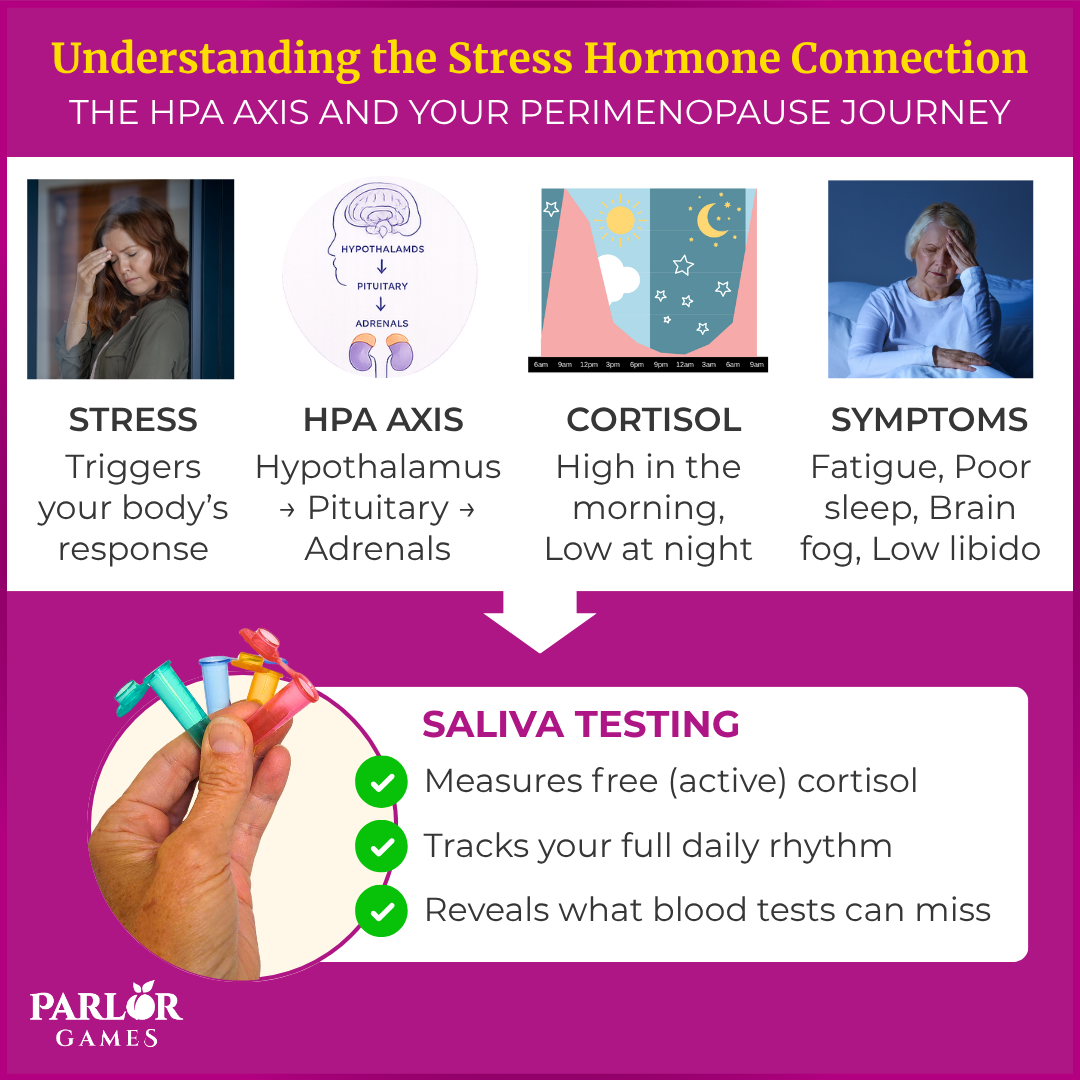
The HPA axis is your central stress-response system. When your brain perceives stress (emotional, physical, or internal), it initiates a message that travels through a hormonal cascade:
Hypothalamus → Pituitary → Adrenals → Cortisol release.
Cortisol is the “stress hormone” that helps you handle immediate challenges, but ideally it should rise and fall with your daily rhythm — peaking in the morning and decreasing as the day goes on, with its lowest levels occurring at night.
When this rhythm gets disrupted — which can happen with chronic stress, poor sleep, inflammation, hormonal fluctuations and more — the whole system can become dysregulated. According to a 2025 integrative review on HPA axis dysfunction, chronic stress and lifestyle pressures can profoundly alter how your cortisol system functions, influencing fatigue, mood, and your ability to tolerate stress stress.
Routine lab work usually measures hormones like estrogen, progesterone, thyroid, and sometimes cortisol in the blood. But cortisol in the blood doesn't tell the full story of how your body is regulating stress over the entire day — especially when it comes to the portion of cortisol available to your tissues.
This has real clinical implications:
You could have what appears to be normal cortisol on a blood test, yet your cortisol rhythm is shifted.
In fact, for many women experiencing symptoms of hormonal changes, their cortisol rhythm may appear flattened or blunted — a pattern tied to chronic stress, overwhelm, burnout, and many perimenopausal symptoms.
That’s where saliva testing comes in!
Salivary cortisol testing measures free cortisol — the portion of cortisol that’s biologically active and available for your cells. Because it’s collected multiple times throughout the day (e.g., morning, midday, evening and night), it gives a daily rhythm profile rather than just a single snapshot.
This matters because:
In other words, salivary cortisol gives a more functional picture of how your body lives with stress — especially during the hormonal rollercoaster of perimenopause.
Many women come to me thinking that perimenopause symptoms are just due to estrogen /progesterone imbalance. While that’s a big piece of the puzzle, there’s another layer: stress hormones and the HPA axis. Without assessing cortisol patterns, we can miss a deeper driver of symptoms.
Here’s why this matters:
That’s part of why saliva testing for cortisol is so useful — it helps to identify the patterns associated with these concerns rather than a snap shot in time that may look “normal.”
If you’ve ever been told:
“Your labs are normal, so there’s nothing to fix,” saliva testing can often reveal what a single lab draw misses.
Salivary cortisol panels can show shifts in a daily cortisol curve, including:
This information helps healthcare providers tailor interventions — not just hormone replacement — but also stress regulation, sleep support, adaptogen support, lifestyle shifts, and more.
For example:
And these patterns can be invisible and overlooked without saliva testing.
Perimenopause isn’t just about estrogen and progesterone — it’s about how your whole endocrine orchestra is responding to change and stress. The emerging research on HPA axis dysfunction shows that:
If you’ve tried hormone support, sleep aids, or stress reduction but still feel stuck, a saliva cortisol panel can be a powerful next step. It gives you data about your daily rhythm, not just a snapshot in time.
Your body is trying to tell you something — and with the right tools, you can finally hear it.

Lorem ipsum dolor sit amet, consectetur adipiscing elit.
Lorem ipsum dolor sit amet, consectetur adipiscing elit.
Lorem ipsum dolor sit amet, consectetur adipiscing elit.
Lorem ipsum dolor sit amet, consectetur adipiscing elit.
Disclaimer: The information provided above is intended for educational and informational purposes only. Statements made have not been evaluated by the FDA nor are they intended to treat or diagnose. Any health concerns should be discussed and evaluated by your primary health care provider.
Parlor Games, LLC ● kate@parlor-games.com ● 5304 River Rd N Ste B ● Keizer OR 97303
Disclaimer: The information provided above is intended for educational and informational purposes only. Statements made have not been evaluated by the FDA nor are they intended to treat or diagnose. Any health concerns should be discussed and evaluated by your primary health care provider.
28 Day Challenge Subscription Details

We ship you a 28 day supply of Silky Peach Cream for only $29 (more than 25% off our normal price) when you sign up for Subscribe & Save.
Follow the directions we include in the package and apply Silky Peach cream on your tender bits for 28 days.

Decision Day:
5 days before your subscription rebills, we’ll send you an email reminder with a link. If you decide Silky Peach is nice but not your thing… you can click that link and cancel your subscription without even talking to anyone. No hassle — no questions asked.
If you are like 72% of our Silky Peach customers, you’ll love it and can't imagine life without it. In that case, do nothing, and we’ll welcome you to the Parlor Games family and ship Silky Peach Cream to your door step every month for the same discounted price of $29 — locked in for as long as you remain a subscriber.

Important note about our easy-breezy subscriptions:
We know that some companies make it hard to cancel a subscription — that’s not us. Our mission is to save the world — one vagina at a time! If you decide you don’t need Estriol as an ongoing solution for dryness, incontinence, UTIs and keeping sex fun and comfortable again, we understand. Five days before we ship your next order, you'll receive an email with a link to cancel right there in the message.
No hunting, no searching, we got you. Respect is where it’s at.
FYI – Estriol is beneficial for skin integrity and mucous membranes. It’s great for vaginal atrophy and also amazing for use on the face and neck. Applying a small amount — about 1 pump — can help build the collagen and plump up the cells to reduce wrinkles. Who knew!!
OUR HAPPINESS GUARANTEE
We want you to feel safe and confident trying any of our products. That's why we promise 100% money-back guarantee on the purchase price of the first bottle of any of our products. Balancing hormones DOES take some time, so please try it for 28 days. If after 28 days you are unhappy, or the product just hasn't worked for you, simply contact us and we'll process a refund of your full purchase price upon receipt. Sorry, shipping fees are not refundable.
