
CLICK TO SHOP OUR BLACK FRIDAY SALE!
*Excludes BioNude and subscriptions
Guest Authored by Dr. Robyn Kutka
Experiences like soul-crushing insomnia, annoying hot flashes and surprising zero-to-b*tch mood swings are often blamed on shifting estrogen levels. And less-recognized changes like itchy skin, scalp irritation or a general sense of being "off" are lumped into the same hormone bucket.
And yet, even when accounting for changes in additional hormone players like progesterone and testosterone, women may still notice changes and still don't feel like themselves.
They often find themselves wondering:
Why am I so irritated by the little things? They never used to bother me before.
Where did my motivation go?
Why don't I have the energy to exercise?
Why does getting through the day feel like a full-body effort?
When did staying home with my dog start sounding better than spending time with the people I love?
It's easy to assume the loss of energy, spunk and patience is just part of aging or something that has to be endured.
But that's not likely the case.
There's an important, overlooked hormone at play here: cortisol
Cortisol is a steroid hormone made in the adrenal glands — small glands that sit atop the kidneys. It is critical in:
And while cortisol often gets a bad reputation as the "stress hormone" we need to detox from, it's not the enemy. In fact, it's essential for life.
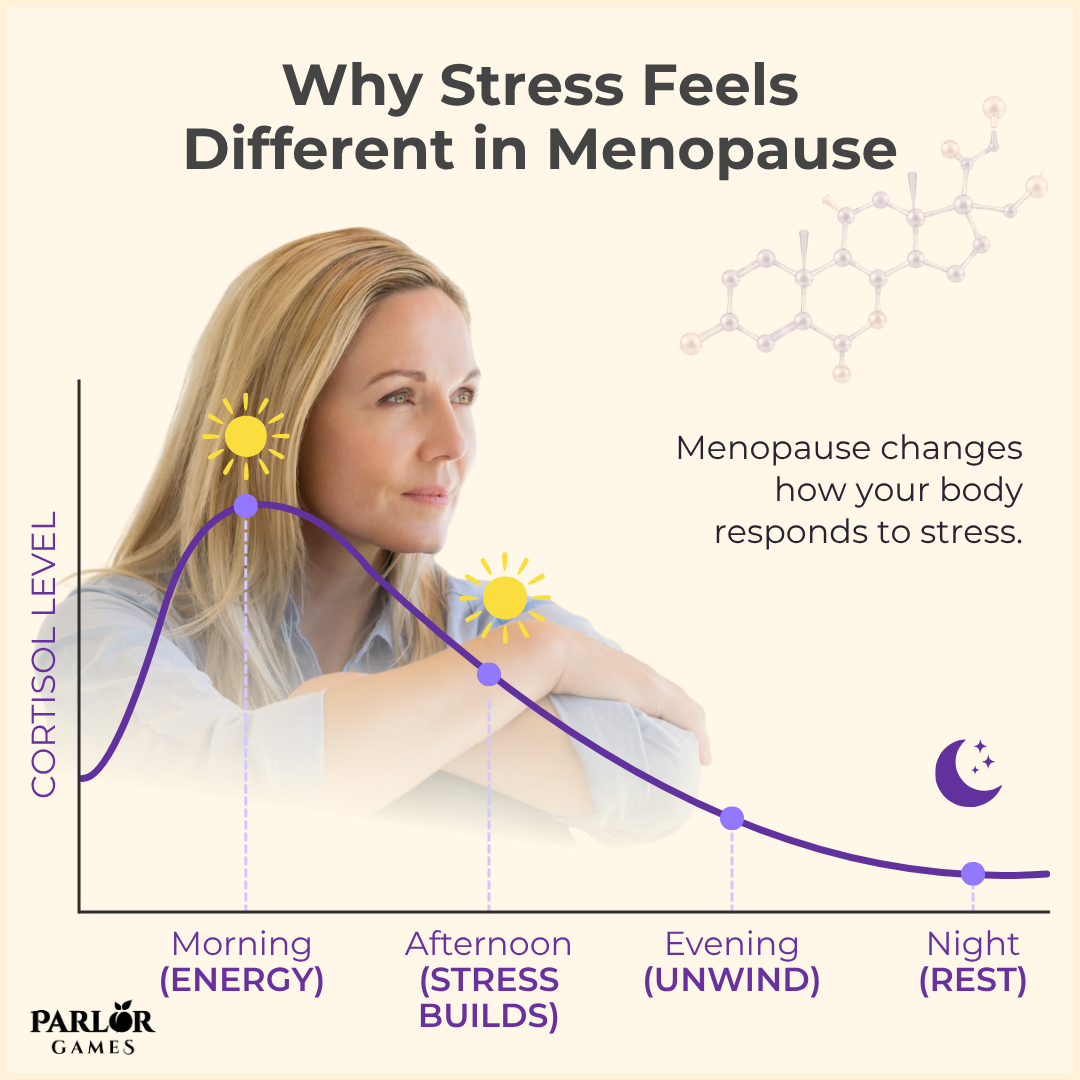
It is made by the body throughout the day and, in a healthy system, it follows a predictable daily rhythm — often referred to as the diurnal cortisol curve. Levels rise within the first 30 minutes after waking (referred to as the cortisol awakening response), then gradually decline throughout the day, reaching their lowest point at night.
This rhythm helps to regulate energy during the day and support restful sleep at night.
Cortisol doesn't work on its own. It's part of a tightly regulated system known as the hypothalamic-pituitary-adrenal (HPA) axis.
Here's how it works:
This cascade prepares the body for action — commonly known as the "fight or flight" response — by:
Once the stressor resolves, cortisol should return to baseline.
That's how the system is designed to work.
Here's where things get more interesting — and more relevant.
The HPA axis is activated by perceived stress, but that perception happens at the level of the brain — not always at the level of conscious awareness.
In other words, your body can be in a stress response even when you don't feel stressed.
These are what I often refer to as hidden stressors.
They include things like:
Even though you may not label these as "stress," the brain interprets them as threats to stability — and activates the HPA axis accordingly.
This helps explain a pattern that comes up often:
A woman says, "I'm not that stressed — I don't know why I feel this way."
And she means it.
From a psychological standpoint, she may not feel overwhelmed. But from a physiologic standpoint, her body may be experiencing repeated or sustained HPA axis activation throughout the day.
The result?
When both visible stressors (life demands) and hidden stressors (internal physiologic signals) are present, the HPA axis can be activated far more often than we realize.
And if the system doesn't get enough time to reset, cortisol patterns begin to shift — not because the body is failing, but because it's adapting to what it perceives as a constant need for vigilance.
In modern life, stress is rarely a one-time event.
Instead, it's chronic, cumulative, and often invisible:
For many women, these stressors intensify during perimenopause — a life stage already marked by biological change.
Repeated activation of the HPA axis without adequate recovery time can lead to HPA axis dysregulation.
This is often what people are referring to when they use the term "adrenal fatigue."
Let's clear something up.
The term "adrenal fatigue" isn't recognized as a formal medical diagnosis. And technically, it's not the adrenal glands themselves that are "fatigued."
But that doesn't mean the experience people are describing is incorrect.
What most women — and many clinicians — are actually referring to when they use the term adrenal fatigue is dysregulation of the hypothalamic-pituitary-adrenal (HPA) axis.
In other words, this isn't a problem of the adrenal glands failing. It's a problem of how the brain and body are communicating and responding to stress.
And this concept is far from fringe.
A large body of research is indexed in the medical literature examining the HPA axis and how chronic stress impacts its function. This research shows that stress can alter:
Importantly, these changes don't look the same in everyone.
Some individuals may have higher cortisol output. Others may show a flattened or blunted daily pattern. Both can be associated with experiences like fatigue, mood changes, sleep disruption, and reduced resilience to stress.
So while "adrenal fatigue" may not be the most precise term, it has persisted for a reason — it reflects a recognizable pattern of stress-related change that many women notice, especially during perimenopause.
Perimenopause doesn't just affect reproductive hormones — it also impacts the brain and stress-response systems.
Hormonal influence on the HPA axis
As hormone levels change (think declining progesterone and estrogen), neurotransmitters are affected.
While estrogen influences how we perceive stress, progesterone plays a critical role in how we regulate it.
Progesterone is broken down into compounds (most notably allopregnanolone) that enhance the activity of GABA (gamma-aminobutyric acid) — the brain's most inhibitory, or calming, neurotransmitter.
GABA acts as a natural brake on the nervous system and stress response. It helps:
GABA also modulates the HPA axis, helping to keep cortisol output in check.
During perimenopause, progesterone levels often decline earlier and more steeply than estrogen due to reduced ovulation.
As progesterone drops:
This has direct consequences for cortisol regulation:
In reality, this can feel like:
Estrogen does far more than regulate reproductive tissues — it plays a central role in brain chemistry and stress regulation.
One of its key effects is on serotonin, a neurotransmitter involved in mood, emotional stability, and stress perception. Estrogen supports serotonin by:
When estrogen levels fluctuate or decline — as they do in perimenopause — serotonin signaling becomes less stable.
This has two important downstream effects:
1. Mood becomes more vulnerable
Lower or more erratic serotonin activity is associated with increased anxiety, irritability, and low mood.
2. The stress response becomes more reactive
Serotonin helps regulate the brain's perception of stress and modulates activity within the HPA axis. When serotonin signaling is disrupted, the brain is more likely to interpret situations as stressful — and to activate the HPA axis in response.
The result?
When you combine:
You get a nervous system that is both:
From a physiologic standpoint, this reflects a shift in HPA axis regulation — where cortisol is not necessarily always "too high" or "too low," but less well controlled.
This helps explain why women in perimenopause often feel:
It's not "just aging."
It's a shift in how the body processes and responds to stress.
HPA axis dysregulation is often reflected in changes to the diurnal cortisol curve. In the research, this is commonly described as a blunting of the slope (less variation between morning and evening levels) and a reduction in the total cortisol output over the course of the day (sometimes referred to as the area under the curve).
With this in mind, when it comes to assessing cortisol, context matters.
Blood cortisol testing is useful for identifying serious endocrine disorders like:
However, it provides only a single snapshot in time. Levels can also be influenced by the stress of the blood draw itself, which may temporarily elevate cortisol.
Importantly, blood testing does not evaluate for HPA axis dysregulation. Rather, it helps determine whether the adrenal glands are producing cortisol within an expected range.
Salivary testing allows for multiple measurements throughout the day, offering insight into:
Because it captures cortisol at several points, salivary testing allows us to visualize the daily pattern of cortisol release.
And it's within this pattern — specifically the slope of the curve and the total output across the day — that signs of HPA axis dysregulation are most often identified.
Despite a substantial body of research on the HPA axis, it often gets sidelined in clinical care.
Why?
Because:
Modern medicine excels at identifying disease — but struggles with dysregulation.
The goal is not to eliminate stress — that's not realistic or necessary.
The goal is to restore balance between activation and recovery — between your sympathetic ("go, go, go") state and your parasympathetic ("rest and restore") state.
Because when it comes to the HPA axis, it's not just about how much stress you have — it's about how often your body is being pulled into stress without enough time to come back down.
And that includes both visible stressors (work, relationships, life demands) and hidden stressors — the physiologic inputs your brain interprets as stress, even if you don't consciously feel overwhelmed.
Supporting cortisol, then, becomes less about "doing more" and more about reducing the total stress load your system is responding to.
Ways to support this include:
Cortisol is not the villain of perimenopause and menopause — but it is a key player.
As estrogen and progesterone decline, the body's ability to regulate stress begins to shift. What changes isn't just hormone levels — it's how the brain and body perceive, respond to, and recover from stress.
At the same time, many women are navigating an increase in both visible stressors (career demands, family responsibilities, life transitions) and hidden stressors — the physiologic signals, like poor sleep, blood sugar fluctuations, or inflammation, that the brain quietly interprets as stress.
The result is a higher total stress load.
And when that load consistently exceeds the body's ability to recover, the HPA axis begins to adapt. Cortisol patterns shift — not because the body is broken, but because it's doing its best to keep up with ongoing demand.
This is why so many women in perimenopause describe feeling:
Understanding this changes the conversation.
It moves us away from blaming a single hormone — or dismissing what women notice altogether — and toward a more complete picture of how the body is functioning.
Because the goal isn't to eliminate stress or chase perfect hormone levels.
It's to support the system as a whole — to reduce total stress load, improve recovery, and restore resilience.
And when that happens, women don't just "get through" this phase of life.
They start to feel like themselves again — maybe even better.
Parlor Games products are not intended to treat, cure, prevent, or mitigate disease or other medical conditions. Our products are not the subject of the studies discussed herein, and we do not claim that our products will have the same effects as those discussed in these articles. This information is being provided for educational purposes only, and is not intended to replace the advice of a medical professional.

Lorem ipsum dolor sit amet, consectetur adipiscing elit.
Lorem ipsum dolor sit amet, consectetur adipiscing elit.
Lorem ipsum dolor sit amet, consectetur adipiscing elit.
Lorem ipsum dolor sit amet, consectetur adipiscing elit.
Disclaimer: The information provided above is intended for educational and informational purposes only. Statements made have not been evaluated by the FDA nor are they intended to treat or diagnose. Any health concerns should be discussed and evaluated by your primary health care provider.
Parlor Games, LLC ● kate@parlor-games.com ● 5304 River Rd N Ste B ● Keizer OR 97303
Disclaimer: The information provided above is intended for educational and informational purposes only. Statements made have not been evaluated by the FDA nor are they intended to treat or diagnose. Any health concerns should be discussed and evaluated by your primary health care provider.
OUR HAPPINESS GUARANTEE
We want you to feel safe and confident trying any of our products. That's why we promise a 100% money-back guarantee on the purchase price of the first bottle of any of our products. Finding your balance takes time — so please give it a full 28 days. If after 28 days you're unhappy, or it just wasn't the right fit, simply contact us and we'll process a full refund of your purchase price upon receipt. Shipping fees are not refundable.
