
CLICK TO SHOP OUR BLACK FRIDAY SALE!
*Excludes BioNude and subscriptions
Are you in your late thirties or early forties and wondering why your body feels like it’s been hit by a truck, given a shot of meth, and survived a nuclear holocaust? Is it burnout, perimenopause, because you skipped yoga this week, or are you just going insane?
It’s the last one - you’re going insane…
This article is for educational and general wellness purposes only. It is not medical advice and is not intended to diagnose, treat, cure, or prevent any disease. If you are noticing changes in your body or have questions about your health, please consult a knowledgeable healthcare provider.
Ok, not really, but maybe a little because it's 2026 and we're in the era of information and yet, somehow, inexplicably, women still don't get taught anything about perimenopause and menopause, and because aging (still) = scary and bad.
Now, before our eyerolls detach our retinas, let's take a closer look at how a lot of women 38–45 are feeling…
You go to bed at 9pm (like a good girl!) only to lie in bed with your mind spinning until after midnight. You then wake up at 4am, decide it's too early to get up (even though you're wide awake) so fall asleep till your alarm at 7am — at which time you feel like a cross between the Walking Dead and that 'Tired Toddler' Gif.
Or, you go to work, only to find your brain has left the building. And your motivation. And your ability to deal with Jean from accounting and the fact that she wants to show you all her photos of Barcelona…
By the time you get home at 4pm, you feel as if you completed a marathon, AND everyone is being SO annoying — leading to a volcano of tears, rage, hysterical laughter, and your kids looking at you as if you might be clinically insane.
These aren't failures.
These are experiences many women share during the hormonal shifts of perimenopause.
Here's a fun (completely unprovable) fact: Definitions around perimenopause and menopause are truly terrible.
Menopause = 12 consecutive months without a period.
Perimenopause = the transition period before menopause.
Well, now we're all clued in…
Exactly.
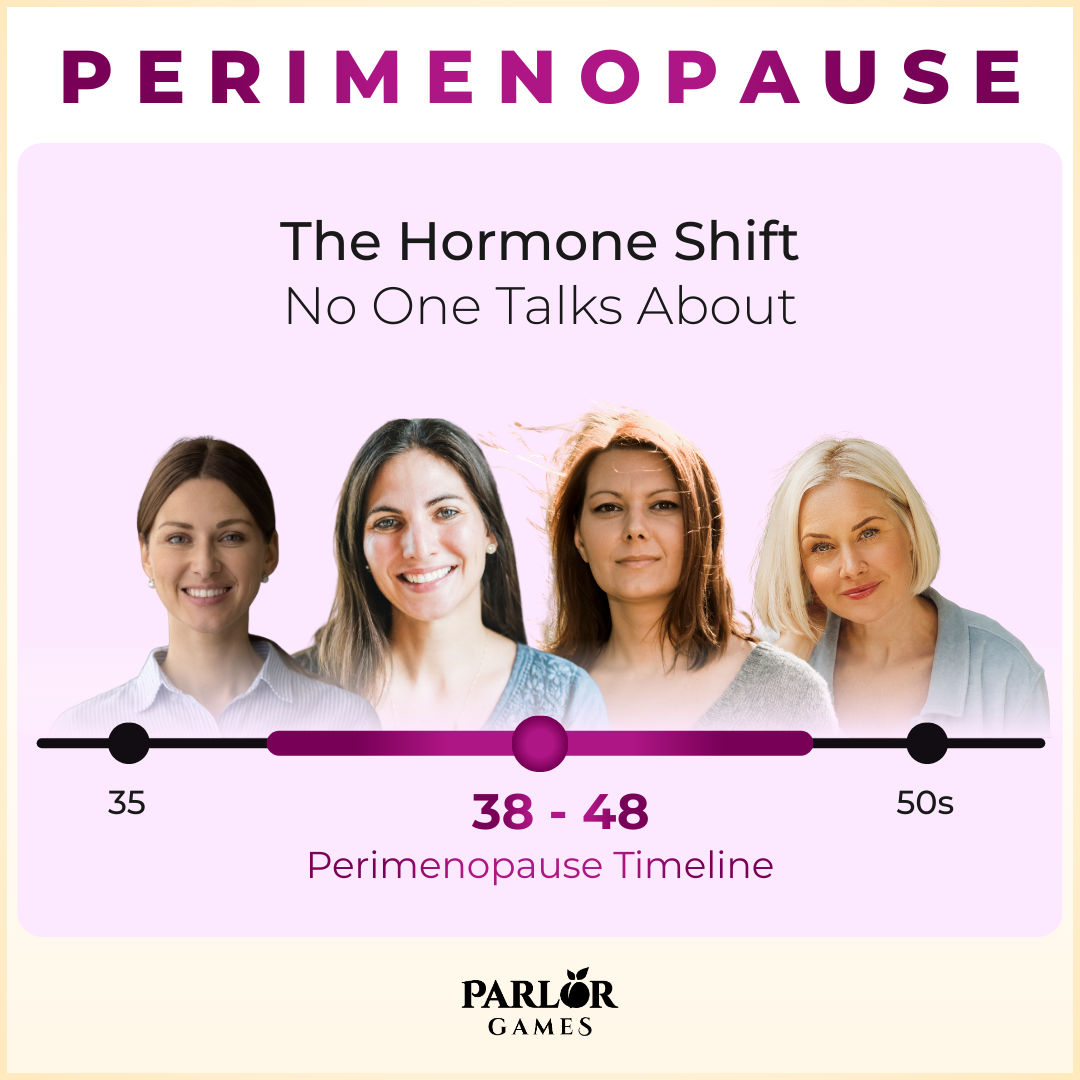
The average age of menopause is 51, and perimenopause is defined as the transition period before menopause ranging 'typically' from 4–10 years. This doesn't give us much to go on, and it certainly doesn't help us navigate our bodies during this time — but crucially, it also doesn't highlight the fact that hormone decline and fluctuations actually begin around age 35.
At around age 35, our progesterone begins to decline — super slowly at first and then the rate of decline picks up. With over 400 functions in the body, it's not exactly something our body cherishes having less of. This also means estrogen has less progesterone to balance it, meaning estrogen 'feels more powerful', as it doesn't have its progesterone throttle working as effectively (this is more accurately described as the hormone gap).
The result of this is significant:
Notice anything about these?
They are also things that can be attributed to your diet, your workout, your kids/partners, your career, and ultimately end up being labeled as either a personal failing or Superwoman Burnout… we'll come back to that later — but first, let's take a look at how sex hormone changes are connected with cortisol.
Cortisol is our stress hormone — and contrary to what you've heard, this isn't some internal toxin that you've got too much of — it is, in fact, a very necessary hormone to keep you alive.
The problem (for poor cortisol) is that it has a really bad reputation.
Cortisol is associated with the stress response. We all have a capacity to deal with (and effectively manage) stress, but when we experience consistent stress, our stress-threshold (the amount of stress we can sustainably deal with) becomes lower. When this happens, small things feel like big things:
📩 You have to go to the post office today? End. Of. The. World.
💔 Your kid backtalked? They obviously don't love you anymore.
🔪 Your husband forgot lemons for the garnish? Kill him.
Cortisol is made from progesterone so, while a woman may have adequate progesterone, a stress-filled life may mean that the body converts a lot of that progesterone to cortisol. Cortisol goes up, progesterone goes down. In addition, that extra cortisol may sit on the progesterone receptors meaning that progesterone can't get there and do its work.
Saliva testing can provide a snapshot of your hormone levels throughout the day, which some women find helpful for understanding their patterns. Cortisol levels ideally peak in the morning, then slowly descend to their lowest point at bedtime.
Sometimes cortisol patterns can feel out of balance — levels that are higher or lower than your body is comfortable with, or rhythms that don't quite follow the usual arc. This can look like:
Whether it's being too rage-y or how much makeup we wear, women catch a lot of flack for being emotional, fragile, and hysterical in all the ways our wandering wombs can permit.
Our hormones fluctuate throughout the day and across the month, they are powerful chemical messengers and so of course fluctuations and changes will have an impact — well duh!
It also means that we can begin to experience burnout, since we have to work harder to incorporate these changes, and it can be disheartening if we don't see tangible results. This is common and super frustrating — and it is another reason why hormone testing can provide unique insight into what's going on with you.
We have real things going on… We need real data (and real options!).
The problem with lifestyle changes — even the good ones like eating more greens and working out — is that they don't take into account the individual and their unique hormone patterns.
Enter, Saliva Hormone Testing with Cortisol.
Saliva Hormone Testing looks at all your sex hormones: all three estrogens, progesterone, testosterone, and your adrenal hormones: DHEA, and four measures of cortisol throughout the day.
A good lab will report results and provide reference ranges for specific hormone stages like premenopause or post-menopause. Reference ranges matter because "normal" just means statistically common, not necessarily what feels right for you. Reference ranges help contextualize your results — some practitioners use ranges associated with women who report feeling their best, though individual results will vary.
The really good news is that testing gives you data to help you understand the changes you have been experiencing. Women are often so relieved to know that they are not going crazy/murdery/falling apart — it's that their hormones have moved in ways that explain what they've been noticing.
Hormone testing is a way to see what your body is actually doing instead of guessing, blaming your willpower, or assuming you are just bad at being a woman in 2026.
Sometimes the most radical thing you can do to love yourself and those around you is stop guessing and start understanding.
Parlor Games products are not intended to treat, cure, prevent, or mitigate disease or other medical conditions. Our products are not the subject of the studies discussed herein, and we do not claim that our products will have the same effects as those discussed in these articles. This information is being provided for educational purposes only, and is not intended to replace the advice of a medical professional.

Lorem ipsum dolor sit amet, consectetur adipiscing elit.
Lorem ipsum dolor sit amet, consectetur adipiscing elit.
Lorem ipsum dolor sit amet, consectetur adipiscing elit.
Lorem ipsum dolor sit amet, consectetur adipiscing elit.
Disclaimer: The information provided above is intended for educational and informational purposes only. Statements made have not been evaluated by the FDA nor are they intended to treat or diagnose. Any health concerns should be discussed and evaluated by your primary health care provider.
Parlor Games, LLC ● kate@parlor-games.com ● 5304 River Rd N Ste B ● Keizer OR 97303
Disclaimer: The information provided above is intended for educational and informational purposes only. Statements made have not been evaluated by the FDA nor are they intended to treat or diagnose. Any health concerns should be discussed and evaluated by your primary health care provider.
OUR HAPPINESS GUARANTEE
We want you to feel safe and confident trying any of our products. That's why we promise a 100% money-back guarantee on the purchase price of the first bottle of any of our products. Finding your balance takes time — so please give it a full 28 days. If after 28 days you're unhappy, or it just wasn't the right fit, simply contact us and we'll process a full refund of your purchase price upon receipt. Shipping fees are not refundable.
